generationword.com home page
Bible School Home Page
| Introduction | Alphabet | Vocabulary | "If" | Nouns | Verbs | Study Tools |
|---|
All English
Bibles are a translation of the original language. The Old Testament was written in Hebrew and
Aramaic. The New Testament was written
in koine, or “common” Greek. Until about 110 years ago the language of the
New Testament was thought to be a special form of Greek developed by the
apostles as they combined their Jewish culture with the Greek language or even
a special “holy ghost” language only used in writing scripture. But around 1900 the increase of the discovery
of ancient documents written on papyri and preserved in the dry Egyptian
climate for 2,000 years from the same time period as the writing of the New
Testament have shed new light on the Greek language. It revealed that the language of the original
New Testament documents was the Greek used in the streets by common people
every day.
In the
classic Greek period, 850-400 BC, there were three dialects of Greek, one for
each of the three main Greek tribes: Doric, Aeolic and Ionic. Homer wrote in Ionic in the 800’s. By the 400’s Ionic Greek had developed into the
Attic dialect. Attic Greek became the
most widely used and the language of the great Greek writers such as Herodotus,
Plato, Socrates, Thucydides, and even Aristotle (384-322). When Alexander the Great (356-323) was a boy
he was sent from his father, Philip, the king of
One of the
key papyri discoveries is known as the Oxyrhynchus Papyri. In 1896 in the
ancient Egyptian city of
|
“The New Testament is written simply in the popular form of the Koine
which J. Gresham Machen, D.D., LITT.D.,
1923 |
|
“There is no sphere of knowledge where one is repaid more quickly for
all the toil expended. Indeed, the
Englishman’s Greek Concordance almost makes it possible |
Introduction to the Greek Language
In these
next few pages you will be introduced to the Greek letters, some basic Greek
words, understanding of Greek verbs and a few other insights. The goal is to introduce you to the bare
basics of the language to enable you to
read and understand what the Greek scholars have written and to use the study
tools they have produced. We want to
take heed to A. T. Robertson’s words from his book The Minister and His Greek New Testament that this “might seem to encourage the charlatan and
the quack. It is possible for an
ignoramus to make a parade of a little lumber of learning to the disgust and
confusion of his hearers.”
The Greek Alphabet
The large
or capital letter in the Greek is called the “uncial” and the smaller letter is
called the “minuscule”.
A a . . . a ALPHA a
as in father 1
B b . . . b BETA b
as in bat 2
G g . . . g
GAMMA g as in go 3
D d . . . d DELTA d
as in down 4
E e . . . e(short) EPSILON e as in bed 5
Z z . . . z or dz
ZETA z as in zero 7
H h . . . ey(long) ETA e as in they 8
Q q . . . th THETA th
as in theology 9
I i . . . i IOTA i’s
as in indian 10
K k . . . k KAPPA k
as in keen 20
L l
. . . l LAMBDA l as in light 30
M m . . .m MU m as in music 40
N n . . . n NU n as in novel 50
X x . . . x XI x as in axe 60
O o . . . o (short) OMICRON o as in omelet 70
P p . . . p PI p as in pull 80
R r . . . r RHO r as in road 100
S s(V) .s SIGMA s as in sing 200
T t . . . t TAU t as in tiger 300
U u . . . u UPSILON u as in “hoop” 400
F f . . . f (ph) PHI f as in foot 500
C c . . . ch CHI ch as in loch 600
Y y . . ps PSI ps
as in lips 700
W w . . o (long)OMEGA o
as in note 800
(V is used if it is the
last letter of a word; s is used all other times in the
word)
(The number 6 is represented by the obsolete letter
digamma, the number 90 is represented by the obsolete letter koppa and the
number 900 is represented by the obsolete letter san.)
Writing the
Letters
Make copies of this page so you can
trace the following letters and practice writing the Greek letters.
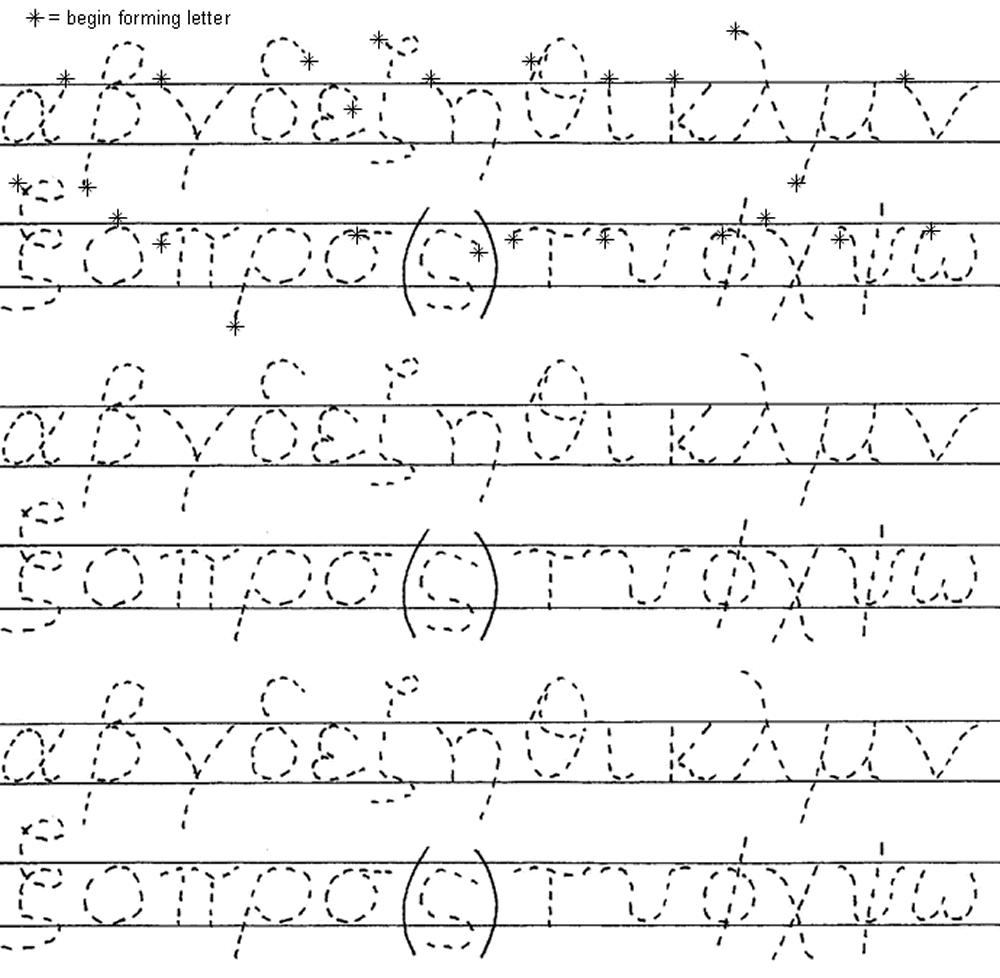
Fill in the Greek Letter
Write the Greek
minuscule or small letter on the blank
________ . . . a ALPHA
________ . . . b BETA
________ . . . g GAMMA
________ . . . d DELTA
________ . . . e EPSILON
________ . . . z or dz ZETA
________ . . . ey ETA
________ . . . th THETA
________ . . . i IOTA
________ . . . k KAPPA
________ . . . l LAMBDA
________ . . .m MU
________ . . . n NU
________ . .
. x XI
________. . . o OMICRON
________. . . p PI
________ . . . r
________. . . s SIGMA
________ . . . t TAU
________. . . u UPSILON
________ . . . f (ph) PHI
________. . . ch CHI
________ . . . ps PSI
________ . . . o OMEGA
Practicing Recognizing
and Pronouncing the Greek Alphabet
1. Say the Greek alphabet in this correct order:
a b
g d e z h q i k l m n x o p r s (V) t u f c y w
2. Say these ten Greek letters that are similar to our
English letters:
a b
d e i k o V t u
3. Say these fifteen Greek letters that are less
familiar:
g z
h q l m n x p r s f c y w
4. Say these seven Greek vowels:
a e
h i o u w
5. Say these Greek consonants
b h
d z q k l m n x p r s V t f c y
6. Say these Greek letters that are written in reverse
order of the Greek alphabet:
w y
c f u t (V) s r p o x n m l k i q h z e d g b a
7. Say this first line of random Greek letters:
m t
e q p b o k a w d l i V z x c f y s g h n r u
8. Say this second line of random Greek letters:
r k
e t k o p d q a f u V c b g w y i z h l
x s m
9. Make flash
cards with the Greek letter on one side and the corresponding English
letter on the back.
Vowels,
Diphthongs, Breathing Marks in Greek
These vowels are always short: e o
These vowels are always long: h w
These vowels must be observed to determine if they are
long or short: a i u
Diphthongs are two vowels that are combined to make one
sound. These are the Greek diphthongs:
ai = ai as in aisle
au = au as in kraut
ei = ei
as in height
oi = oi
as in boil
eu = eu as in feud
ui = as in the sound in wee
ou = as in soup
Every Greek word that begins with a vowel has one of two
breathing marks. The first is the smooth
breathing mark that looks like this ’ and appears before the word like
this ’ek .
The word ’ek is pronounced just like it is written
as “ek”.
The second is the rough breathing mark that looks like
this ‘ and
appears before the word like this ‘ektoV. The word with this rough breathing mark
before the vowel is pronounced with an “h” sound before the vowel is
pronounced.
The word ‘ektoV is
pronouned “hektos”.
Pronounce these words or dipthongs:
’en . . . . . . .
. . . . (“en”)
‘en . . . . . . .
. . . . (“hen”)
‘ou . . . . . . . . . . ._________
’ou . . . . . . . . . . ._________
’oikou . . . . . . . . _________
‘oikoV . . . . . . . . _________
Pronouncing Greek Letters
Below are
some English words written in Greek letters.
Pronounce these words.
- dig bhb kid lap
- bklh men laq am
- ill lamb gab bag
- abba bed dad zeb
- egg angel qh zid
- ep larkin polis sit
- stand nix los thm
- lift fil ‘it ’up
Pronouncing Greek Words
Below are
Greek words written in the Greek script. Pronounce these words
1.
telioV polis kardia fobos
2.
bhma cariV yuch didwmi
3. ’oikia ginomai ’autoV ’eimi
4.
sabbaton ’egw ’anqropoV gar
5. ‘uios ’eipon ‘agioV pistiV
6.
fwnh dunamai gunh logoV
7.
’oikia kurioV qeoV ‘amartia
Greek
Vocabulary
- Greek words used more than 500
times in the Greek New Testament:
- ’anqrwpos man
- ’apo from
- ’autoV himself, herself, itself, same
- gar for
- ginomai I become
- de but, and
- dia through
- ’egw I
- ’eimi I am
- ’eipon I said
- ’eiV into
- ’ek, ’ex out of, from
- ’en in
- ’epi over, on, at, to, against
- qeoV God
- kai and, even, also
- kata down from, against, according to
- kupioV lord
- legw I say, I speak
- ‘o the
- ‘h the
- to the
- ’ou not
- ’ouk not
- poiew I do, I make
- proV to, towards, with
- ‘Greek’ words used 200-500 times in
the Greek New Testament:
- ‘agioV holy
- ’adelfoV brother
- ’akouw I hear
- gh,
ghV the earth
- ginwskw I come to know or learn
- gunh woman, wife
- didwmi I give
- dunamai I am powerful, I am able
- ’ean if
- ’ei if
- ’eidon I saw
- ‘eiV, mia,‘en one
- ‘hmera day
- qelw I will, I wish
- lalew I speak
- lambanw I take, I receive
- logoV word
- maqhthV disciple
- meta with
- ’oida I know
- ’ouranoV heaven
- pathr father
- peri concerning, about, around
- pistiV faith
- pneuma spirit
- poluV much
- ‘uioV son
- ‘upo by, under
- Greek words used 150-200 times
in the Greek New Testament:
- ’aggeloV angel (two gg together make the “ng” sound in Greek)
- ‘amartia sin
- basileia kingdom
- grafw I write
- doxa glory
- ’eqnoV nation, Gentiles
- ’ergon work
- ’esqiw I eat
- ‘euriskw I find
- ’idou see!
behold!
- ‘isthmi I stand
- kaqwV as, even as
- kardia heart
- kosmoV world
- megaV large, great
- nekroV dead
- nomoV law
- ’ocloV crowd, multitude
- para from
- poliV city
- cariV grace
- ceir hand
- Greek words used 100-150 times
in the Greek New Testament:
- ’aiwn an
age
- ’agaqoV good
- ’agaph love
- ’alhqeia truth
- ’alloV other, another
- ’amhn truly, amen
- ’apostellw I send, apostle
- ’arciereuV high priest
- Ballw I throw
- basileuV king
- Blepw I see
- douloV slave
- dunamiV power
- duo two
- ’ekklhsia assembly, congregation, church
- ’exousia authority
- zaw I live
- zwh life
- qanatoV death
- ’idioV one’s own
- krinw I judge
- laoV people
- nun now
- ‘odoV road, journey
- ’oikoV house
- ‘oloV whole
- ’oude not, not even, neither, nor
- profhthV prophet
- sarx flesh
- sarkoV flesh
- swzw I save
- sun with
- swma body
- fwnh sound, voice
- yuch soul, life, self
- Greek words used less than 100
times in the Greek New Testament:
- gennaw I begat
- didaskw I teach
- ’eirhnh peace
- ‘eteroV other, another, different
- kaloV good, beautiful
- ’arcw I rule
- baptizw I baptize
- fwtoV light
- ’aiwnioV eternal
- nux night
- pistoV faithful
- presbuteroVelder
- ‘rhma word
- sabbaton Sabbath
- qronoV throne
- kakoV bad,
evil
- mikroV small, little
- Biblion book
Transliteration
Transliteration
is when the Greek word is sounded out and written with English letters. For example:
’anqropoV is transliterated as anthropos
a . . . . . . a
n . . . . . . . . n
q . . . . . . . . th
r . . . . . . . . r
o . . . . . . . . .o
p . . . . . . . . p
o . . . . . . . . .o
V . . . . . . .
. s
Transliterate
the following words (you may want to check the page with Greek letters):
’anqropoV _____________________________
kurioV______________________________
qeoV _______________________________
’eimi________________________________
legw_______________________________
kai_________________________________
Translation
Translation
is when the Greek words are changed into English words with out changing the
meaning of the original Greek.
Translate
the following:
‘agioV___________________
’adelfoV_________________
’akouw__________________
ginwskw________________
gunh___________________
‘hmera_________________
logoV___________________
maqhthV__________________________
’ouranoV _________________________
pathr___________________
pistiV___________________
Which Greek
word would be used in the verse “In the beginning was the word”?
maqhthV logoV ‘hmera
Jesus had
twelve of these:
pistiV ‘agioV maqhthV
The
opposite of anqropoV is:
pathr gunh ’adelfoV
Translate
these into all English:
The ’adelfoV had
great pistiV ________________________
akouw ‘agioV logoV
_____________________________
ginwskw the pathr en ’ouranoV______________________
qeoV kai ’anqropoV ____________________________________
kurioV
qeoV ____________________________________
legw ’eimi_______________________________________
Recognizing the Conditions of “If”
or “ei”
There are
two parts of a conditional sentences (or, a sentence with an “if” clause)
The two
parts are:
a) The subordinate clause, or “if”
clause which states a supposition or condition
b) The principle clause, or
“conclusion” clause, which states the result if the “if” clause is fulfilled.
Example: “If you get there early (this is the subordinate
or “if” clause)
then you will get a good seat (this is the principle or conclusion
clause)”
The Greek
word ei is translated
into English as “if”, or ”whether.” This
word will be found in the first part or the subordinate clause of a
conditional sentence.
The Greek
word an is an
untranslated word whose presence in a clause introduces the element of
contingency. It will be found in the
second part or the principle clause of a conditional sentence.
Here is an
example from the Greek interlinear:
ei ek tou kosmou
hte
If of
the world you were
o kosmos
an to idion
efelei
the world would
its own have loved.
First Class
Condition – View point of Reality
This is ei plus indicative mood with conclusion clause in any mood and any tense.
This is the
viewpoint of reality. It means “if, and
it is assumed to be true” or “if, and I know it is true.”
Examples:
“But if you are led by the Spirit, you are not under law.”
Galatians 5:18
“If you really knew me, you would know my Father as well.”
John 14:7
“If you are the Son of God, tell these stones to become
bread.”
Matthew 4:3
“If you are the Son of God, throw yourself down.”
Matthew 4:6
In each of
the above cases the subordinate clause, or the “if” clause is assumed to be
true by the speaker. So Paul tells the
Galatians, “If you are led by the Spirit and I assume you are, you are not
under the law.” When Satan is tempting
Jesus he is saying, “If you are the Son of God, and I know you are, tell these
stones to become bread.” According to
this statement Satan was not trying to get Jesus to prove to he that he was the
Son of God because Satan already knew who he was.
Second
Class Condition – Viewpoint of Unreality
This is ei plus imperfect tense with conclusion clause an plus imperfect tense. This is the viewpoint of unreality. It means, “If, but I know you won’t” or “If,
but I know it won’t happen.”
Examples:
“If this man were a prophet, he
would know who is touching him and what kind of woman she is.” Luke
7:39
“If you belonged to the world, it
would love you as its own.”
John
15:19
“If I had not come and spoken to
then, they would not be guilty of sin.”
John
15:22
“All this I will give you, if you
will bow down and worship me.”
Matthew
4:9
Also, ei plus aorist or pluperfect tense with conclusion clause an plus aorist or pluperfect tense.
Examples:
“Lord, if you had been here, my
brother would not have died.”
John
11:32
“If the miracles that were preformed
in you had been performed in
Matthew
11:21
In each of
the above cases the subordinate clause, or the “if” clause is assumed not to be
true or to be impossible by the speaker.
So when the Pharisee says “If this man were a prophet” he is actually
saying, “If this man were a prophet, and I know he is not, then he would know
who is touching him.” When Satan says,
“If you will bow down and worship me” he is saying, “If you will bow down and
worship be but I know that you won’t.”
Third Class
Condition – Viewpoint of Uncertainty
This is ei plus Subjunctive mood with
conclusion clause in any verb form. This
is a statement of the unknown because it infers a matter of volition. It means “maybe you will or maybe you won’t.
Examples:
“If I only touch his cloak, I will
be healed.”
Matthew
9:21
“If we confess our sins he is
faithful and just and will forgive us our sins and
purify us from all unrighteousness.” First John 1:9
In each of
the above cases the subordinate clause, or the “if” clause was unknown. The woman did not know if she would get a
chance to touch Jesus’ cloak even though she was sure of the results if she
did. She was saying, “Maybe I will and
maybe I won’t be able to touch his cloak, but if I do, I will be healed. John writes, “If we confess our sins, maybe
you will and maybe you won’t, but if you do he is faithful and just and will
forgive us.” These are in the class of
possibilities and unknown volitional decisions.
Fourth
Class Condition – Viewpoint of Improbability
This is ei plus the optative mood with conclusion clause an plus optative mood.
This is speaks of a unlikely
future condition. It describes the less
probable future and the remoteness of the event occurring. It expresses, “if it is true but it probably
is not”, or “I wish it were true, but it is probably not.”
Examples:
“But even if you should suffer for
what is right, you are blessed.”
First
Peter 3:14
Peter is
saying here, “if you suffer for doing right, but it is highly unlikely”. The logic that supports this if the fact that
both God and men approve of people who do good.
|
Conditions of “If” or “ei” |
|||
|
Class |
Viewpoint |
Statement |
Example |
|
First |
Reality |
“If, and I know it to be true.” |
Mt. 4:3, 6 |
|
Second |
Unreality |
“If you will, but you won’t” |
Mt. 4:9 |
|
Third |
Unknown |
“If, maybe you will, maybe you won’t” |
1 Jn. 1:9 |
|
Fourth |
Unlikely |
“If, I wish it were true, but it is not” |
1 Pt. 3:14, 17 |
generationword.com home page
Bible School Home Page
| Introduction | Alphabet | Vocabulary | "If" | Nouns | Verbs | Study Tools |
|---|

Greek Prepositions
ana


kata upo


pros = towards ano = above uper = over, above eiV = into dia = through epi = upon, on en = in upo = under ana = up ek = out of, from kata = down para = beside, in presence of, away
from, along side These prepositions can also
mean: dia = on account of meta = with, after upo = by sun = with apo = off
Greek Nouns
A noun can
be used in five different ways in a sentence.
The ending attached to the noun will determine where it fits in the
sentence.
Nominative The subject of the verb
“God
is love.”
Genitive Possessive as in “cross of
Christ”
Descriptive
as in “crown of thorns”
Dative Indirect object
“he preaches
to the people”
Accusative Direct object
“I read the
book”
“I see the
angel”
Vocative Expresses direct address
“Athenian
men! Acts 17:22
“Lord God
Almighty” Revelation 11:17
In the
Greek there are three forms of nouns: masculine, feminine and neuter. These are the masculine noun endings in
Greek:
|
Masculine Noun Endings |
||
|
|
Singular |
Plural |
|
Nominative |
-oV |
-oi |
|
Genitive |
-ou |
-wn |
|
Dative |
-w |
-oiV |
|
Accusative |
-on |
-ouV |
|
Vocative |
-e |
-oi |
|
Singular Noun Endings for ‘uioV |
||
|
Nominative
(Subject) |
‘uioV |
The son
is a man. |
|
Genitive
(Possessive) |
‘uiou |
The life of
the son. |
|
Dative
(Indirect Object) |
‘uiw |
Life is in
the son. |
|
Accusative
(Direct Object) |
‘uion |
We saw the
son. |
|
Vocative
(Direct Address) |
‘uie |
Son! We are here. |
The Greek Article
The Greek
language does not have an indefinite article.
This means that when nouns like maqhthV or ’apostoloV are written they
mean “disciple” or “apostle” or an indefinite disciple or apostle written as “a
disciple” or “an apostle”. Since this is
clear in the Greek it is incorrect to translate it into English with the
definite article “the” as “the disciple” or “the apostle”. In other words, the definite article should
not be inserted in the English unless the definite article is in the Greek.
The
definite article in English is “the”.
This makes the distinction between “a book on the shelf” and “the book
on the shelf.” If I ask for “a book”
then any book will do. If I ask for “the
book” then I am thinking of and looking for a specific book. The definite article in the Greek is used,
for example, with the word logoV is o. If the Greek text says logoV then the correct translation would
be “a word” or just “word”. If the Greek
text says o logoV then the
correct translation would be “the word”.
|
Greek Articles: Indefinite and Definite |
|||
|
Indefinite (“a”) |
Definite (“the”) |
||
|
logoV |
“word” or “a word” |
o logoV |
“the word” |
|
qeoV |
“God” or “a god” |
o qeoV |
“the God” |
|
zwh |
“life” or “a life” |
‘h zwh |
“the life” |
|
’alhqeia |
“truth” or “a truth” |
‘h ’alhqeia |
“the truth” |
Greek verbs are written to show a tense, a voice, and a mood
- Tense
- Imperfect Tense – conveys continuous or repeated action in past time.
i.
It
is an action that occurred more than once.
1. Mark 5:18 – “. . .was entreating. .
.”
2. Mark 6:41 – “. . .He kept giving
[repeatedly, over and over again]. . . “
3. As in Luke 3:10, “The multitudes
were asking him questions.”
ii.
It
also conveys habitual or customary action.
1. Matthew 26:55 “Every day I used to sit
in the temple teaching.”
2. 1 Peter 3:5, “. . .used to
[customarily] adorn themselves.”
- Aorist Tense – conveys point of action in the past. The action is viewed as a completed whole
or a one-time action. This is determined by the text.
i.
Effective
or successful action as in First Timothy 1:3, “. . . you may (effectively)
instruct certain men” or Second Timothy 2:4, “. . . so that he may
(successfully) please. . . “
ii.
Single
one time action as in Matthew 5:28, “looks on a woman to lust (even once) . . .
“
iii.
Action
wrapped up as a single package as in Luke 17:4, “If he sins against you seven
times a day, and returns to you seven times.” In this case “sins” and “returns”
include all the possible occasions of these acts in one single idea.
iv.
Also
in John 2:20, “The temple was built in forty-six years.”
v.
Helping
words: effectively, successfully, completely, even once, ever, as a whole,
indeed, in fact, actually, really do.
- Perfect Tense – conveys completed action in the past with finished
results still abiding in the present
i.
Indicates
that a past event is now completed or it has a continuing effect or consequence
in the present
ii.
As
in Ephesians 2:8-9, “For by grace are you saved” which means “For by grace have
you been saved in the past with the result that you keep on being saved
forever.”
iii.
Hebrews
1:4 – “He has inherited [and now still has]. . .”
iv.
Hebrews
2:9 – “. . .crowned [and now still is] with glory and honor. . .”
v.
Hebrews
12:2 – “and has sat down [and now still is seated] at the . . .”
vi.
The
sense most often conveyed by the perfect tense is the continuance of the effect
of the action (not the action itself).
vii.
John
19:30 – “It is finished!” The perfect
tense brings out that the results and effects of His sacrificial death are
anything but over and finished.
- Pluperfect Tense – conveys completed action in the past with
finished results in the past.
i.
As
in John 19:22, “What I have written, I have written.”
- Present Tense – conveys continuous or habitual action
i.
Continuous
or uninterrupted action is seen in John 15:4, “unless it (continuously) abides
. . . unless you (continuously abide) . . . “
ii.
Action
that happens over and over again is seen in Matthew 10:1, “. . .to (repeatedly ) cast them out, and to (over
and over again) heal every kind of disease.”
iii.
Customary
or habitual action is seen in Matthew 7:12, “. . . you (customarily) want
people to (customarily) treat you.”
iv.
Helping
words to express the present tense: continuously, repeatedly, over and over again,
uninterruptedly, constantly, deep on, customarily, habitually.
- Future Tense – Action planned for a future time
i.
As
in John 3:36, “Shall not see life.”
- Voice – expresses relation between the subject of a verb and
the verb’s action
- Active Voice
i.
The
subject causes or produces the action of the verb
ii.
“I
throw the ball”
iii.
As
in Acts 16:31, “Believe in the Lord Jesus, and you will be saved.” In this verse the verb “believe” is in the
active voice which means the subject of the sentence which is “you” or the Philippian
jailer, causes or produces the action of the verb “believe.”
- Middle Voice
i.
The
subject is involved in the action, most often in the interest of the subject
itself.
ii.
As
in John 15:16, “You have not chosen me, but I have chosen you.” The verb “have chosen” in the middle voice
indicates that this verse means, “You nave not chosen me for your benefit, but
I have chosen you for my benefit.”
- Passive Voice
i.
The
subject receives the action of the verb
ii.
As
in Ephesians 2:8, “By grace are you saved”
iii.
The
subject “you” receives the action of the verb “are saved” but the subject is
not active in causing the verb.
iv.
Notice
the active voice in Acts 16:31 above combined with passive voice in Ephesians
2:8 indicates that when you “believe” (active voice of Acts 16:31) then you
receive salvation (passive voice of Ephesians 2:8)
- Mood – refers to the manner in which an action is conceived
by the speaker The four moods
show the way an action is to be regarded: fact, potential action, command,
wish.
- Indicative Mood – is the mood of reality
i.
It
indicates that the verb really happened, at least in the mind of the speaker.
ii.
As
in John 1:1, “In the beginning was the word.”
- Subjunctive Mood – is the mood of potential
i.
It
indicates that the verb could potentially happen
ii.
John
14:31, “Come now, let us leave.”
iii.
“Jesus died (indicative mood) that all might
(subjunctive mood) saved.
- Imperative Mood – is the mood of command
i.
Verbs
in the imperative mood carry the force of a command
ii.
As
in First Corinthians 11:24, “Do this in remembrance of me.”
iii.
persecute you.”
- Optative Mood – is the mood expressing a wish or desire
i.
As
in Second Thessalonians 3:5, “May the Lord direct your hearts into God’s love
and Christ’s perseverance.”
ii.
It
is a polite request without any connotation of anticipated realization.
iii.
It
has an air of perplexity or possibility.
Combinations of Tenses and Moods
Present Imperative
Orders or
commands that are expected to have continuous or repeated application are given
in the present tense. Therefore, the
present imperative essentially means, “Follow this command as often as the
situation or need arises.”
- Second Corinthians 13:5 – “Test
yourselves to see if you are in the faith; examine yourselves!”
- 1 Corinthians 16:13 – “Be. .
.stand. . .act. . .be. . .” (each bring out the call to a long-term
commitment conveyed by this tense.
3.
Present imperative commits you to a process.
a.
usually
relates to a more general and recurring situation.
b.
calls
for a long-term way of doing something.
c.
focuses
on the broader consideration of life-style.
Aorist Imperative
This moves away from the
call to a long-term commitment of the present
imperative to the call for a specific and definite decision.
1.
John
15:4 – “Abide in Me,” is not primarily dealing with a future kind of
life-style, but rather with a call for a definite preference regarding
fellowship with Himself.
2.
Aorist imperative compels you to a choice.
a.
usually
relates to a particular and specific situation.
b.
calls
for a decisive choice to effectively accomplish an action.
c.
focuses
on decision.
Negative
present Imperative
In the
majority of cases, the negative present imperative has the meaning “Stop doing
this!”
- John 20:17 – “Do not touch
Me.” Does not say “Do not touch me
at all,” but, says, “Stop touching Me.”
Negative
Aorist Imperative (Subjunctive)
Has a
different focus than the negative present imperative. Negative present imperative stresses on forbidding that an action
continue. Negative aorist imperative
lays the stress on the action never happening at all.
- 2 Timothy 1:8, “therefore do
not be ashamed [never at any time] of the testimony of our Lord.”
Parsing Verbs
Every verb
has a stem or root word that identifies the meaning of the verb. This stem serves as the unit upon which the verb
tenses are built. Different endings are attached
to the stem to express the following information:
- Tense
- Voice
- Mood
- Person (as in first, second or
third person)
- Number (as in singular or
plural)
Here is an
example of parsing the verb legw which means “to say, to speak”:
|
Parsing the Verb legw |
||||||
|
|
Person |
Number |
Tense |
Mood |
Voice |
Translation |
|
legw |
First |
Singular |
Present |
Indicative |
Active |
I am saying |
|
legeiV |
Second |
Singular |
Present |
Indicative |
Active |
You are saying |
|
legei |
Third |
Singular |
Present |
Indicative |
Active |
He is saying |
|
legomen |
First |
Plural |
Present |
Indicative |
Active |
We are saying |
|
legete |
Second |
Plural |
Present |
Indicative |
Active |
You (all) are saying |
|
legousi |
Third |
Plural |
Present |
Indicative |
Active |
They are saying |
Here are some other forms of the legw:
|
|
Person |
Number |
Tense |
|
Voice |
Translation |
|
lege |
Second |
Singular |
Present |
Imperative Mood |
Active |
Tell me (Ac.22:27) |
|
legein |
|
|
Present |
Infinitive |
Active |
|
|
legwn |
Third |
Singular |
Present |
Indicative Mood |
Active |
|
|
legesqai |
|
|
Present |
(Infinitive) |
Passive |
|
|
legetai |
Third |
Singular |
Present |
Indicative |
Passive |
He is being told |
|
legete |
Second |
Plural |
Present |
Imperfect |
Active |
(same word 2, pl, Pr., In., Ac.) |
|
legetw |
Third |
Singular |
Present |
Imperfect |
Active |
|
|
legh |
Third |
Singular |
Present |
Subjunctive |
Active |
|
|
leghte |
Second |
Plural |
Present |
Subjunctive |
Active |
|
There are thirty-two more forms of legw that include legomena which is accusative neuter plural
participle present passive, legomenh which is nominative feminine singular participle present
passive and others.
This is
just one Greek word with a introductory look at its forms. Imagine the enormous amount of information is
needed to know and understand all of the Greek words and their parsing. This is a job for a Greek scholar. Fortunately many Greek scholars have put
their knowledge and research in books and other study tools that can assist us
in understanding more of the scriptures.
Greek Study Tools
There are
books and study aids available for the believer to assist them in Bible
study. It is important to realize both
our limitations in our own personal knowledge of Greek but at the same time the
inexhaustible supply of resources we have available to study Greek. There has never been a time before in history
that so many accurate study tools written by a variety of thoroughly trained
Greek scholars have been readily available for a believer who wanted to gain
insight into God’s written revelation.
Here are some of the Greek study tools:
- Greek Text – Scholars have worked through all the appropriate
Greek manuscripts to produce the best Greek New Testament. There will be footnotes explaining which
manuscripts or papyri were used to defend their chosen text. The footnotes will also include
alternative readings called textual variants.
- Greek/English Interlinear – A translator has taken the
Greek text and translated each line word for word into English.
- Greek Grammars – A text book by a Greek teacher that takes you step
by step through the process of learning the Greek language.
- Greek Concordance – Scholars have taken every Greek word in the
Greek New Testament and listed them in alphabetical order along with each
of its scripture references. The
portion of the scripture with the word in it is shown.
- English Concordance – Each English word from a particular
translation is listed alphabetically along each of its scripture
references. A portion of the verse
is written out showing how the word is used.
- Greek Lexicon – Is a dictionary but more. A lexicon will also provide examples of
how the word was used in other writings near the time of the New
Testament. The entry in the lexicon
will cite writers such as Josephus, Herodian, Tacitus, Socrates and
hundreds more to give a full sense of the meaning and what the word meant
to those who heard it 2,000 years ago.
Newer lexicons will also site examples from the papyri and recent
manuscript discoveries.
- Greek Dictionary – A Greek Dictionary can provide a simple one to three
word definitions which is good for a quick reference. Also, Greek Dictionaries can become
several volumes as each piece of evidence is referenced, discussed and
brought to a theological and scriptural definition. These are useful for more controversial
verses and topics.
- Greek Reference Sets – Are similar to commentaries but the author
focuses on the exegetical work from the meaning of the Greek and
linguistic insights.
- Other Reference Tools – Other books that are useful
are word study books, lexical aids, linguistic keys, and reference works
that help bring the Greek New Testament a little closer to the reader.
Here are
some samples of the above Greek study tools from my own bookshelf:
- Greek Text
- The New Testament: The Greek Text Underlying the
English Authorized Version of 1611. This is known
as the Textus Receptus or the Received Text used in the
translation of the King James Bible
- Nestle-Aland Greek New Testament (or, Novum Testamentum Graece)
which is the Greek text used to translate the New International
Version, New American Standard
- Greek/English Interlinear
- The Interlinear KJV-NIV Parallel New Testament in
Greek and English, translated by Alfred Marshall.
The Greek text is Nestle’s Greek New Testament based on the
comparison of texts edited by Tischendorf (1869-1872), Westcott and Hort
(1881) and Weiss (1894-1900)
- Greek Grammar
- New Testament Greek for Beginners, by J. Gresham Machen, D.D.,
Litt.D., Macmillan Company, 1923
- New Testament Greek, by James Allen Hewett, B.A., B.D., M.A.,
Ph.D., Hendrickson Publishers, 1986
(I was fortunate to be able to sit in on some Mr. Hewett classes
in 1988.)
- New Testament Greek Primer, by Alfred Marshall, Zondervan
Publihsing House, 1962
- Beginners’ Grammar of the New Testament, by William Hersey Davis, M.A.,
Th.D., Harper & Row Publishers, 1923
- Essentials of New Testament Greek, by Ray Summers, Broadman
Press, 1950
- Greek Concordance
- Wigram Englishman’s Greek Concordance of the New
Testament,
George V. Wigram, Baker Book House, 1979
- English Concordance
- Strong’s Exhaustive Concordance of the Bible, James Strong, L.L.D., S.T.D,
World Bible Publishers, 1890.
|
Strong’s Concordance and Key Numbers |
|
James
Strong made a concordance that shows every English word in the text of the
King James Version. Each Greek word in
the New Testament (and also, each Hebrew and Aramaic word of the Old
Testament) is numbered. This way a
student can look up the English word in Strong’s
Concordance, find the verse they are referring to then look at the number
listed beside the verse. This number
can be referenced in the back of Strong’s
concordance in the simple Hebrew dictionary (numbers are in regular
straight font) or in the simple Greek dictionary (numbers are in italic
font). In the dictionaries in the back
by Strong’s number you will find
the: ·
Greek word in Greek letters, ·
the Greek word transliterated into English letters, ·
the pronunciation of the Greek word, ·
reference to the base word or related word, ·
a brief definition and ·
some English words used to translate the Greek word. The only
skill the student needs is to know the Bible verse and numbers up to
5624. The same system is used for the
Old Testament and Hebrew, but the numbers go up to 8674. Strong’s work is based on the best
scholarship from the 1800’s before the huge influx of ancient papyri were
discovered and analyzed. |
- Nelson’s Complete Concordance of the Revised Standard
Version of the Bible, by John William Elllison, Nelson, 1957
- The NIV Exhaustive Concordance, Edward W. Goodrick and John
R. Kohlenberger, III, 1990
- The New Strong’s Exhaustive Concordance of the Bible, James Strong, Nelson, 1984.
- Nelson’s Complete Concordance of the New American Bible, edited by Stephen J.
Hartdegen, Nelson, 1977.
- Greek Lexicon
- Thayer Greek-English Lexicon of the New Testament, by Joseph Henry Thayer,
D.D., Baker Book House, 1901.
- BDAG, or officially, A
Greek-English Lexicon of the New Testament and Other Early Christian
Literature. The original
author was the German scholar Walter Bauer who produced four German
editions between 1910 and 1952.
Arndt and Gingrich translated it to English in 1957. This was the
work of Bauer, Arndt, Gingrich and Danker. This second English edition
was published in 1979 by Gingrich and Danker. It was known as BAGD (Bauer, Arndt,
Gingrich and Danker). It has now
undergone a third edition by Danker in 2000. This third edition is known as BDAG and
contains over 15,000 new citations.
- Greek Dictionary
- A Concise Greek-English Dictionary of the New
Testament, by
Barclay M. Newman, Jr., 1971. This
is a simple 200 page, dictionary with short definitions.
- Vine’s, or officially, Expository
Dictionary of New Testament Words, by W. E. Vine, Zondervan,
1940. This is a classic. Words are listed alphabetically in
English from the King James translation.
The definition the English word includes a definition for each of
the Greek words that were translated into the English word. Definitions, references are given
beside the transliteration and the Greek word.
- Kittel’s, or officially,
Theological Dictionary of the New Testament (TDNT), edited by Gerhard
Kittel, by Eerdmans, 1964, 10 volumes.
An extensive dictionary that references the Greek word’s use in
classical Greek writing, in the Greek Septuagint, and in the New
Testament times. There are 39
contributing authors.
- The New International Dictionary of New Testament
Theology, edited
by Colin Brown, Regency, 1967, 4 volumes.
Includes seven contributing authors each an expert in one of these
areas: Greek philosophy and the classics, Old Testament and the
Septuagint,
- The New Strong’s Expanded Dictionary of Bible Words. This takes the dictionary located in the
back of Strong’s Concordance
and combines it with Vine’s
Complete Expository Dictionary, Thayer’s
Lexicon and the Hebrew Lexicon Brown
–Driver-Briggs.
- Greek Reference Set
- Word Studies in the New Testament, by Marvin R. Vincent, D.D.,
1886, 4 volumes.
- The Expositor’s Greek Testament, by W. Robertson Nicoll,
M.A., LL.D., 1897, 4 volumes.
- The New Testament for English Readers, by Henry Alford, 1872, 4
volumes.
- Wuest’s Word Studies from the Greek New Testament, by Kenneth S. Wuest,
writings from the 1940’s and 1950’s.
4 volumes including a New Testament translation
- Other Reference Tools
- The New Linguistic And Exegetical Key to the Greek New
Testament, by
Cleon L. Rogers Jr. and Cleon L. Rogers III, from 1982 and revised in
1998. This goes verse by verse
through the New Testament and highlights the key words. Besides definintions and insights this
volume tells the tense, voice and mood of the verbs. There are 30 pages listing authors and
the sources quoted in this book.
- The Greek New Testament Analyzed, by Pierre Guillemette,
Herald Press, 1986. This book
lists every Greek word and in every form in alphabetical order. The parsing is then written out beside
each form of every word.
- New Testament Words, by William Barclay
- Light from the Ancient East, by Adolph Deissmann
- Bible Studies, by Adolph Deissmann
- Grammatical Insights into the New Testament, by Nigel Turner
- Synonyms of the New Testament, by Richard C. Trench
- New Testament Exegesis, by Gordon D. Fee
- Lexical Aids for Students of New Testament Greek, by Bruce M. Metzger
- Building Your New Testament Greek Vocabulary, by Robert E. Van Voorst
- Word Meanings in the New Testament, by Ralph Earle
The Study Process
When
studying the Bible a style of study called ICE was introduced to me by a
legendary pastor and Bible teacher. The
acronym ICE stands for three areas that need to be studied to properly
understand a passage of scripture. The
three areas are isagogics, categories and exegesis.
The first
area, isagogics, is the area of study that is preliminary to the study process
of scripture because it deals with the literary and external history of the
Bible. Isagogics is the study of the
historical background and the setting the scripture was written in. To understand the Bible we must understand
the people, the place, the purpose and the culture it was written in. We need to hear the New Testament letters the
way they would have been heard in the first century.
The second
area is the categories. No scripture
stands alone but must be interpreted in a way that allows it to align with the
rest of the verses that speak to the same subject. This is the classification of Bible doctrine
according to the subject. Theology is
the result of this classification. Many
false doctrines, heresies and cults could be avoided if this were
practiced. The Reformation in the 1500’s
taught that scripture must be compared with other scripture and must be
interpreted so as not to contradict other scriptures. By comparing the scripture you are studying
to scriptures in the same category you will gain insight and set boundaries for
you interpretation.
Exegesis,
the third area, is the interpretation of the scripture from its original
language. The goal here is to let the
scriptures speak to you by letting their language say what it was meant to say.
The word exegesis is from the Greek word
exagw (“exago”)
and is itself made up of two Greek words: ex or ek (“ex-”) is a preposition that means
“from” or “out of” and agw (“ago”) means “to bear, to bring, to lead”. The word exagw then means “to lead out of”. We want to practice exegesis which is to lead
the meaning out of the words and sentences in the Greek New Testament into our
soul. The opposite of this is eisogesis
which is also from a Greek word. This
word in the Greek is eisago (“eisago”) but this time the word ago is proceeded by the preposition eiV or eis- (“eis”) which means “into”. This refers to the practice that comes
naturally to us all (and we all do this at one time or another at some level)
of reading into the scripture what we want it to say or what we think it should
say or what we expect it to say. We do
not want to conform the scripture to our cultural pattern or to what our minds
have decided. Our goal is to hear the scriptures speak to us so that we “do not conform any longer to the pattern of
this world, but are transformed by the renewing of our mind. Then we will be able to test and approve what
God’s will is.” (Romans 12:2) This
is the goal of exegesis. This is the
reason we study and teach using ICE.
|
ICE Study |
|
Isagogics – study the historical background Categories – study the scripture in its
category Exegesis – study scripture in its original
language |
A Study Sample
In the
following sample we will use some of the study tools to look into Ephesians
4:11, 12. The study tools we will be
using are:
- An Interlinear Greek New
Testament
- The Greek New Testament
Analyzed
- The Linguistic and Exegetical
Key to the Greek New Testament
- Thayer’s Lexicon
- A Wigram’s Greek Concordance
- Strong’s English Concordance
- Vine’s Expository Dictionary
- Brown’s Dictionary of New
Testament Theology
- Kittel’s Theological Dictionary
of the New Testament
- Wuest’s Word Studies in the
Greek New Testament
Ephesians
4:11, 12 says in the New International
Version:
“It was he who gave some to be
apostles, some to be prophets, some to be evangelists,
and some to be pastors and teachers, to prepare Gods’ people for works of service so that the body of Christ
may be built up.”
The word we
want to gain some insight into is the word “prepare” in Ephesians 4:12.
We now turn
to the interlinear New Testament and
look up the verse:
kai ’autoV ’edwken touV men
’apostolouV
touV de
and he gave some apostles some
profhtaV touV de ’euaggelistaV
touV
de
prophets
some evangelists some
poimenaV kai didaskalouV proV ton katartismon
shepherds
and teachers for the perfecting
twn ‘agiwn ’eiV ’ergon diakoniaV
’eiV ’oikodomhn
of the
saints to work of ministry to building
tou swmatoV
tou cristou
of
the body - of Christ
The word
“prepare” in the NIV is translated in this interlinear as “perfecting”. Here we get our first look at the Greek word
that is being translated. It is the word
katartismon. The transliteration would be “katartismon”.
We now turn
to a book called The Greek New Testament Analyzed and look up the verb katartismon to find the parsing (tense, voice, mood, etc) and also its
lexicographic entry or the dictionary form of the word which is the simplest
form of the word. Here we find this
entry:
11235 Eph. 4:12 katartismon (1) acc. sg . . . .
. . . . . . . katartismoV
This tells
us the following:
- It is the 11,235 entry in this
parsing guide
- It is used in Ephesians 4:12
- The word we are looking at is katartismon
- The (1) indicates that this
form of the word is used only one time in the Greek NT
- It is in the accusative which
means this is the direct object form of this word
- It is singular and not plural
- The basic word is katartismoV
Before we
go to the Linguistic and Exegetical Key,
we will first go to a lexicon and look up katartismoV, the basic form of this word. Here we find this entry at the top of page
336 in Thayer’s Lexicon:
katartismoV, - ou, o, (katartisiV, q. v.: tinoV eiV ti, Eph. iv. 12. [(Galen, al.)}*
This entry
is not very useful but we do see that this word was used by the Roman medical
doctor Galen (129-216 AD) who served as the personal physician to Marcus
Aurelius. The * at the end of the entry
indicates all the uses of this word have been listed. It only appears in Ephesians 4:12.
The Linguistic
and Exegetical Key is organized by New Testament book, chapter and
verse. The first word listed under
Ephesians 4:12 is katartismoV. The entry says:
katartismoV (#2938) equipping,
qualification. The word was a medical
t.t. for the setting of a bone (BAGD; for the vb. s. TLNT). The noun describes the dynamic act by which
persons or things are properly conditioned. (Barth; Lincoln).
This entry
gives us a number (#2938) but it is not Strong’s number. This number is from the more recent numbering
system called the Goodrick-Kohlenberger number. The newer NIV Exhaustive Concordance uses
this numbering system. The next thing
listed is a definition which saying this word means “equipping,
qualification.” Then we read that it was
a medical t. t. which means it was a technical term (t.t.) used in medicine at
that time and referred to setting a bone.
This would have been why Thayer’s says that this word is found in the
writings of the medical doctor Galen. We
are then told that this information comes from BAGD which is a lexicon we
discussed above and TLNT which is another Lexicon called The Theological Lexicon of the New Testament from 1994. Two authors, Barth and Lincoln, tell us that
this noun is used to describe the dynamic act that properly conditions people
or things.
Wigram’s Greek
Concordance
looks like this:
2677
katartismoV, katartismos.
Eph.
4:12. For the perfecting
of the saints
The Greek
concordance will list all the appearances of this word in the Greek New
Testament. In this case, there is only
the one use of katartismoV . We are given the
biblical reference, the transliteration and the number 2677 which keyed to
Strong’s English Concordance and dictionary.
Also, notice the translation of the word as “perfect” in the
English. It is in italic in the portion
of the verse that is given. If we check the
King
James Translation we will see this is how the word was translated.
“And he gave some, Apostles: and some, Prophets: and some,
Evangelists: and some, Pastors, and teachers: For the perfecting of the Saints,
for the work of the ministry, for the edifying of the body of Christ.”
We now look
up the word “perfecting” in Strong’s Concordance:
Perfecting
2
Eph. 4:12 For the p. of the
saints, for the . . . . . . . . . . . . . 2677
Here we
find two entries under “perfecting”. We
see the two verses in the King James Bible where the word “p.” or “perfecting” is used.
We are also given Strong’s numbers for each of these words. The word “perfecting” is the translation of
the Greek words numbered 2006 and 2677.
Our verse, Ephesians 4:12, uses the Greek word 2677. So in the same book, Strong’s Concordance, we
turn to the Greek Dictionary in the back and look up 2677:
2677 katartismoV
katartismos, kat-ar-tis-mos’; from 2675;
complete furnishing (obj.): -
perfecting
Strong’s dictionary shows us the Greek word,
the transliteration and, for the first time, we see how the Greek word is
pronounced. It also tells us that this
word is a form of the word numbered 2675 that means “complete furnishing”. We can look up the page in Strong’s to find the word numbered 2675
which is katartizw means
“fit, frame, mend, perfect or perfectly join together, prepare or restore and
comes from a root word that means to complete thoroughly.” In the entry for the word we are studying,
2677 kataprismoV, Strong’s dictionary gives the word
meaning to me “perfecting”.
We can also
look up the King James translation “perfecting” in Vine’s Dictionary. There is a section in Vine’s for the English
words “perfection, perfecting and perfectness”.
Then all the Greek words that are translated into these English word in
the King James are listed. They include
the Greek nouns: katartisiV, katartismoV, teleiwsiV and teleiothV; and the Greek verb telesforew.
Under the
word we are looking at, katartismoV, we find this information:
katartismos (katartismoV) denotes, in much the same way as
No. 1, a fitting or preparing
fully, Eph. 4:12.
When we
look katartismoV up
in the index of Brown’s Dictionary we find it is listed with the word artioV and its many derivatives. Brown’s begins the discussion of artioV from the time of its use in Classic
Greek (CL):
CL artios and its derivatives come from the
root ar- which indicates
appropriateness, suitability, usefulness, aptitude. Artios
accordingly means suitable, appropriated, fitting a situation or
requirements; hence also respectively, normal,
perfect, sound in physical, intellectual, oral and religious respects. IN mathematics it is used to describe what is
straight and to denote even numbers. The
oldest derivative in classic Greek (apart from the Homeric artyo) is the verb katartizo,
to put in order, restore, furnish, prepare, equip. These various meanings have a common origin
in the basic meaning to make suitable, make fitting. Katartismos
and katartisis mean restoration.
Brown’s Dictionary then begins a discussion of the use
of the word in the Septuagint (LXX), the Greek translation of the Old
Testament:
OT
The LXX uses katartizo 19
times, and it stands for no fewer than 9 different Hebrew words . . .
Brown’s
Dictionary then discusses the use of the word in the New Testament (NT):
NT Of this group of
words only katartizo is used at all
frequently in the NT (13 times), while artios
(2 Tim.3:17), katartisis (2 Cor.
13:9), and katartismos (Eph.4:12)
occur only once each.
1. At Matt. 4:21 and Mk. 1:19, katartizo is found in the secular sense
of repairing fishing nets. In addition
to this, the NT also uses katartizo in
the same way as the LXX: the meaning here is to prepare (Heb.10:5, a citation
of Ps. 40:6; Matt. 21:16, citing Ps. 8:3 LXX; Rom. 9:22), to establish, to form
(Heb.11:3), to equip (Heb. 13:21; 1 Pet.5:100.
As in the OT, God is the subject of sentences which express his power to
strengthen and establish.
2. Of particular importance are those
passages in which artios and its
derivatives are used in connexion with the preparation and equipment of the
believer and the church, for the service of God and their fellow-men. The adj. artios
occurs only at 2 Tim. 3:17, together with the perfect pass. Participle exertismenos. . . artios here does not imply perfection, as was originally thought,
doubtless because of the variant reading
teleios, perfect, in Codex D. Rather
it refers to the state of being equipped for a delegated task. So too, in Eph.
4:12 katartismos refers to the
preparation of the church for becoming perfect, but not to this perfection
itself, as can be seen from the use of teleios
(complete, mature). . . The terms artios
and katartismos thus have not so much
a qualitative meaning as a functional one.
Kittel’s Theological
Dictionary has
a paragraph that says:
Along the same lines katartismoV is used at Eph. 4:12, in the
context of the edifying of the
body of Christ, to denote the equipment of the saints for the work of ministry. The establishment of the community in work
for the
in the widest sense thus constitutes
for Paul a material precondition of the
upbuilding and consequently the
actualization of the community.
Wuest writes in his Word Studies in the Greek New
Testament about Ephesians 4:12:
These gifted men are given the
Church “for the perfecting of the saints.”
The word “perfecting” is katartizo, “to equip for service.” These gifted men are to specialize in equipping the saints
for “the work of the ministry,” that is, for ministering
work, in short, Christian service. This
is in order that the Body of Christ,
the Church, might be built up, by additions to its membership in lost souls being saved, and by the building up of
individual saints.”
generationword.com home page
Bible School Home Page
| Introduction | Alphabet | Vocabulary | "If" | Nouns | Verbs | Study Tools |
|---|
_________________________
Marshall,
Alfred, The interlinear KJV-NIV Parallel
New Testament In Greek an d English (Zondervan Publishing House, Grand
Rapids, Michigan, 1975) 569.
Guillemette,
Pierre, The Greek New Testament Analyzed
(Herald Press, Scottdale, Pennsylvania, 1986) 228.
Thayer,
Joseph Henry, A Greek-English Lexicon of
the New Testament (Baker Book House, Grand Rapids, Michigan, 1977) 336.
Rogers,
Cleon L., Jr and Rogers, Cleon L. III, The
New Linguistic and Exegetical Key to the Greek New Testament (Zondervan
Publishing House, Grand Rapids, Michigan, 1998) 441.
Wigram,
George V., The Englishman’s Greek
Concordance (Baker Book House, Grand Rapids, Michigan, 1979) 415.
Strong,
James, Strong’s Exhaustive Concordance of
the Bible (Word Bible Publishers, Iowa Falls, Iowa,1986) 1055.
Strong,
James, Strong’s Exhaustive Concordance of
the Bible: A Concise Dictionary fo the Words in the Greek/New Testament
(Word Bible Publishers, Iowa Falls, Iowa,1986) 53.
Vine, W.
E., Expository Dictionary of New
Testament Words (Zondervan Publishing House, Grand Rapids, Michigan, 1952)
175.
Brown,
Colin, Editor, The New International
Dictionary of New Testament Theology (Zondervan Publishing House, Grand
Rapids, Michigan, 1986) vol. 3, 349.
Kittel,
Gerhard, Editor, Theological Dictionary
of the New Testament (Eerdmans , Grand Rapids, Michigan, 1964) 476.
Wuest,
Kenneth S., Word Studies in the Greek New
Testament (Wm. B. Eerdmans Publishing Company, Grand Rapids, Michigan,
1973) 101.